I knew my recent Third Estate post would date the moment it was put up, and now the Markets have spoken!
There's been 'relative calm' on sterling after Nick Clegg made satisfying noises concerning a Lib-Con coalition, and the FTSE 100 bounced this morning just a bit. The main reaction has been concerning the crisis in Greece; the cost of a Greek bond has plummeted since the E.U bailout was announced.
So, all that worrying for nothing?
No. A positive referendum by business is no better than a negative one; and the elite view remains - that business has a right to vote on elections with the threat of economic retaliation, and to decide the actions of foreign governments.
According to our brave news media, this threat of a run on the pound is hovering over the heads of the party leaders during these negotiations. They've been tamed for now, but there's only so much uncertainty they can can stand. Perhaps their success in making ordinary Greeks pay through austerity measures gave them a pleasant morning. Bastards.
Monday, 10 May 2010

Sunday, 9 May 2010
The real Parliament to worry about.
This piece was a guestpost on thethirdestate.net.
With no party holding an outright majority in Parliament, the negotiations now taking place will effectively do the job of the electorate and decide the next Government. At any time this would be a bloody important decision, but now, with the economy on a precipice, and the threat of Tory cuts in public spending, it's a bit more so.
So who will decide how long these negotiations will take? Constitutional convention? The electorate itself? Possibly. But the leaders know the real limit: the markets open tomorrow, and they must be pleased.
Economists and political scientists have noted for many years the effect that unaccountable financiers can have on the democratic process and government policy. In a mostly unregulated, 'floating' (that is, marketised), currency market, speculators have the power to decide the value of this basket of currencies or that; it is estimated that 90% of currency fluctuations occur for this reason. Speculators can buy up a huge amount of a particular currency - say, pound sterling - and thus increase its value relative to other currencies; or, they can sell off their reserves of this currency, and its value will fall. There's a reason they give you an update on the pound after the weather forecast - this stuff happens to be very important, for any economy.
This means more for Finance than the ability to make a quick buck (or Pound, or Euro, or Peso). Financiers can use this, and often do, to pass an effective referendum on government policy. If Finance is displeased with a government proposal, they can band together (informally, of course - no need for smokey rooms here) and attack the currency. The result is that governments, even with strong mandates, know where not to tread. This effect has been termed the 'virtual Parliament' and it's just placed a limit on coalition negotiations.
We saw a hint of this on election night. After the indecisive early election results, the value of the pound fell as investors felt uncertain about the prospects of any coalition doing what the 'business community' wants, namely to reduce the fiscal deficit. You may have thought that the issue of the size of a government deficit (particularly during a recession, when public spending is so important) was the concern of an elected government and the people affected by its decisions. Think again.
What's even more striking about this is the fact that in all the news coverage of the election and the coalition talks now taking place, no commentator has made this point: that perhaps its a scandal that business has the right to tank a currency when it doesn't like what the People have decided. To my knowledge, the only person to raise this point was Mariella 'thinking man's crumpet' Frostrup, on that rather odd BBC election-night boat party. Andrew Neil (don't get me started) raised this point with some enthusiasm, that if a majority for the Conservatives wasn't achieved then the markets will have their say. She slapped that right back in his very large face, saying it's a 'disgrace' that we should even talk this way during an election. He replied that its 'their' money making up the debt the government has to pay back, but she raised the objection that it's a scandal we've given the markets that power in the first place, and right she was. Surprising that no leftie-luvvie working for the Beeb (Andrew Marr, Robert Peston et al.) raised this point at all. Damn champagne socialists...
It wasn't always this way. The 'Bretton Woods' system decided after the Second World War put in place a system in which world currencies were assigned a fixed value, with little room for speculation. This allowed for capital controls and stable currencies, in a time when the government's role in demand management was seen as legitimate. The era of the Bretton Woods system constitutes what is usually seen as the 'Golden age' of capitalism (as opposed to the 'Leaden age' since then). This was done for two main reasons. First, it was the view of economists and statesmen at the time that wild speculation in currency markets would retard growth and development. In fact, they were right. According the the International Monetary Fund's own report on 'The World Economy in the 20th Century' (2000), the rate of growth in global per capita GDP in the period 1950-73 (the Bretton Woods period) was 2.9%, double the rate of growth after this period during the wonders of financial 'liberalisation'.
But there was another reason. The architects of this system realised that without the ability to control the flow of capital in and out of a country, and with a wildly speculative financial system deciding the value of currencies, there would be no space in which to enact the reforms of which business would never approve. It is highly unlikely that without this control of Finance the social democratic turn in Europe and America would never have taken place. How would 'the Markets' have reacted to the Attlee government? Or progressive taxation? Or the public health-care systems put in place in so much of free Europe?
The period in which the markets Will be done correlates exactly with the rise in global and societal inequality, privatisation, the politics of wage stagnation and that eternal horror, the 'flexible' labour market. The same system that put all that in place has just set a limit on the negotiations between the main parties.
We need to go beyond the 'objective' economic argument about the nationalisation of the banking sector and resurrect the Old Labour-speak about economic control. Who governs the the fate of working people and the economy in which they make their living? The people affected, or our unaccountable friends in the City?
With no party holding an outright majority in Parliament, the negotiations now taking place will effectively do the job of the electorate and decide the next Government. At any time this would be a bloody important decision, but now, with the economy on a precipice, and the threat of Tory cuts in public spending, it's a bit more so.
So who will decide how long these negotiations will take? Constitutional convention? The electorate itself? Possibly. But the leaders know the real limit: the markets open tomorrow, and they must be pleased.
Economists and political scientists have noted for many years the effect that unaccountable financiers can have on the democratic process and government policy. In a mostly unregulated, 'floating' (that is, marketised), currency market, speculators have the power to decide the value of this basket of currencies or that; it is estimated that 90% of currency fluctuations occur for this reason. Speculators can buy up a huge amount of a particular currency - say, pound sterling - and thus increase its value relative to other currencies; or, they can sell off their reserves of this currency, and its value will fall. There's a reason they give you an update on the pound after the weather forecast - this stuff happens to be very important, for any economy.
This means more for Finance than the ability to make a quick buck (or Pound, or Euro, or Peso). Financiers can use this, and often do, to pass an effective referendum on government policy. If Finance is displeased with a government proposal, they can band together (informally, of course - no need for smokey rooms here) and attack the currency. The result is that governments, even with strong mandates, know where not to tread. This effect has been termed the 'virtual Parliament' and it's just placed a limit on coalition negotiations.
We saw a hint of this on election night. After the indecisive early election results, the value of the pound fell as investors felt uncertain about the prospects of any coalition doing what the 'business community' wants, namely to reduce the fiscal deficit. You may have thought that the issue of the size of a government deficit (particularly during a recession, when public spending is so important) was the concern of an elected government and the people affected by its decisions. Think again.
What's even more striking about this is the fact that in all the news coverage of the election and the coalition talks now taking place, no commentator has made this point: that perhaps its a scandal that business has the right to tank a currency when it doesn't like what the People have decided. To my knowledge, the only person to raise this point was Mariella 'thinking man's crumpet' Frostrup, on that rather odd BBC election-night boat party. Andrew Neil (don't get me started) raised this point with some enthusiasm, that if a majority for the Conservatives wasn't achieved then the markets will have their say. She slapped that right back in his very large face, saying it's a 'disgrace' that we should even talk this way during an election. He replied that its 'their' money making up the debt the government has to pay back, but she raised the objection that it's a scandal we've given the markets that power in the first place, and right she was. Surprising that no leftie-luvvie working for the Beeb (Andrew Marr, Robert Peston et al.) raised this point at all. Damn champagne socialists...
It wasn't always this way. The 'Bretton Woods' system decided after the Second World War put in place a system in which world currencies were assigned a fixed value, with little room for speculation. This allowed for capital controls and stable currencies, in a time when the government's role in demand management was seen as legitimate. The era of the Bretton Woods system constitutes what is usually seen as the 'Golden age' of capitalism (as opposed to the 'Leaden age' since then). This was done for two main reasons. First, it was the view of economists and statesmen at the time that wild speculation in currency markets would retard growth and development. In fact, they were right. According the the International Monetary Fund's own report on 'The World Economy in the 20th Century' (2000), the rate of growth in global per capita GDP in the period 1950-73 (the Bretton Woods period) was 2.9%, double the rate of growth after this period during the wonders of financial 'liberalisation'.
But there was another reason. The architects of this system realised that without the ability to control the flow of capital in and out of a country, and with a wildly speculative financial system deciding the value of currencies, there would be no space in which to enact the reforms of which business would never approve. It is highly unlikely that without this control of Finance the social democratic turn in Europe and America would never have taken place. How would 'the Markets' have reacted to the Attlee government? Or progressive taxation? Or the public health-care systems put in place in so much of free Europe?
The period in which the markets Will be done correlates exactly with the rise in global and societal inequality, privatisation, the politics of wage stagnation and that eternal horror, the 'flexible' labour market. The same system that put all that in place has just set a limit on the negotiations between the main parties.
We need to go beyond the 'objective' economic argument about the nationalisation of the banking sector and resurrect the Old Labour-speak about economic control. Who governs the the fate of working people and the economy in which they make their living? The people affected, or our unaccountable friends in the City?
Friday, 7 May 2010
Mandatory Post-Election Post (extra sweary edition)
I've had my fill of commentistas pretending they know what's going on; and now we know we've a 'Hung' Parliament they're hard at it again speculating on possible coalitions. So none of that here. Instead, here's my list of Election 2010 heroes:
1) David Dimbleby
1) David Dimbleby
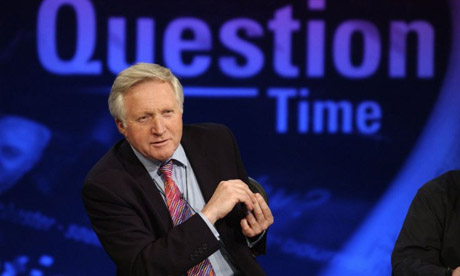
A general election without Dimbleby would be like...a thing without another thing that is very important. (I've slept about as much as Gordon Brown, excuse me). As such, the Dimbster has been on duty from 10pm last night to 9 am. And, as I type, he's back on again.
This man is superhuman. It took an attack by a bull to get him to take his first week off hosting Question Time in decades. Presumably whenever the camera went over to Emily Maitlis on her massive iPad, Dimbleby was taking a bump of cocaine. And all this in the name of democracy.
There were moments when the sleep-deprivation seemed to take its toll, however - and thus the Dimblenator provided my favourite moment of the whole election. Considering the role of the Queen in the event of a hung parliament, Dimbleby announced: 'We go now to our Royalty correspondent, standing outside Buckingham Palace - *absent-mindedly* the Palace...of Buckingham...' Brilliant.
Honourable mention must go, of course, to the other BBC presenters who stayed up well past their bedtimes in the name of news (the aforemtioned Emily Maitlis, Robert Peston, Andrew Marr, baldy Conservato-twat Nick Robinson et al.) but without the Dimbleby British democracy would somehow be far worse off.
Speaking of the state of our so-called Democracy...
2) The Literally Disenfranchised
The only story to overtake the General Election itself was the shocking news of people being kept in enormous queues (and in the rain some places) while an insufficient number of bureaucrats faffed about and denied everybody the right to vote when the clocks struck 10. This is a disgrace, of course, and the electoral commission is going to launch a 'thorough' investigation into the matter.
But the sheer civility of the shafted voters made me so proud to be British. Footage quickly emerged of angry non-voters having a go at polling station staff, and there were plenty of angry interviews to news cameras. Said one: "there were hundreds - particularly young voters - who were queuing for an hour and a half, and I think that it is just not right when hundreds later found themselves unable to excersie their right when the polls closed." Another said, "We've been disenfranchised, and it's not on!"
This is what the British do when denied a fundamental right - queue, and complain. Imagine this in any other country. How would the French react? Or the Greeks, or Romanians, Koreans, you name it? These people showed tremendous patience, lined up in an orderly fashion, became very very displeased and then decided not to kill anyone. I'm not trying to trivialise what was done to these people, and protest in many places went beyond tut tutting and finger wagging (in Hackney they organised a sit-in, and in Sheffield Hallam voters went to Nick Clegg's house with their poll cards to protest). The revolutionary potential of the British is in doubt, but I feel bloody proud all the same.
*Apologies to readers here: my dipshit cunt fucking twat of a shitty fuckwit bastard laptop has just cockblocked me from being able to upload pictures and videos for some fucking reason. 'Technological Revolution' my acheing arse*
2) Caroline Lucas
According to Reuben at the Third Estate, the Green Party assistant press officer was 'almost in tears with ecstacy' over what was, in my view, the most significant win of the whole election. Caroline Lucas, the incredibly impressive and talented leader of the the Green Party, took Brighton Pavilion last night in a close race, and thus Lucas is the UK's first ever Green Member of Parliament.
Now, the strong impression I got from this video, and from the reporting on the election campaign in Brighton, is that the people who voted Green are mostly insufferable arsehole Bohemian types who read the Grauniad, eat organic and...no matter: they won this seat, and well done to them (I guess).
We now have a guaranteed sane person in the Commons, and a real radical.
Good luck Caroline, you'll need it.
3) Mariella Frostrup
Now, if my fucking shit eating bastard motherfucker of a laptop worked as a fucking laptop was meant to, I'd be able to put up a nice picture of the really rather dishy Mariella 'thinking man's crumpet' Frostrup up here, but I can't, for the aforementioned reasons. (I can't even link to a nice picture, as that isn't working either, so just pop 'Mariella Frostrup' into Google images if you require a visual aid).
Anyway. At a very odd election-night event on a boat, featuring everyone from Joan Collins to Simon Schama (really), Andrew Neil sat down with Toby Young, Ian Hislop and Mariella to fill time before the next seat was declared. The subject of the reaction of the financial world was raised (the bankers didn't like the idea of ther Tories not having a big enough majority, and thus the Pound took a dive as uncertainty set in).
From what I could tell, Mariella Frostrup was the only person to challenge the infuriating attitude of every commentator thus far that the whims of completely unaccountable bankers should be considered a perfectly natural part of a general election. Frostrup was visably appalled at Neil's mention of the views and retaliatory actions of the City, and told him outright. He made the case that we should mind what the bankers have to say through their manipulation of the currency, as it's 'their' money the government must pay back, but she slapped that back in his face by saying that it's a disgrace we've become so reliant on the markets in this way in the first place. And right she is.
Later on Stephanie Flanders gave us a full update on the City's reaction, and, again, at no point was the obvious mentioned: that, during an ostensibly democratic election, perhaps the views of finance, expressed in a Ponzi-scheme, shouldn't concern us as much as the views of the elecorate expressed via the ballot box; and that maybe it's a disgrace that business interests are allowed to tank a currency when it doesn't like what the People have decided.
4) Margaret Hodge
Hodge (Labour) managed to soundly defeat Nick Griffin, which is a relief; but the beating the fat goggle-eyed Nazi cunt isn't why she's on this list. Before the declaration for Barking, she gave an interview with Jeremy Paxman, and very confidently dropped the F-bomb several times. The election in Barking, she said, was a defence of 'Democratic values against Fascist values'.
The BNP needs to be called out for what it is: our very own Fascist party. But this isn't said nearly enough. So fuck them. And well done Hodge.
And that's it, I think.
Oh, it should be mentioned that Evan Harris, the Lib Dem MP for Oxford West and Abingdon, lost his seat at this election. This is a phenomenal shame those of us who value science, reason and secularism, all of which Harris worked to defend against an increasing tide of irrationalism. Thus it was Harris who asked a Homeopath in a select committee on the subject of 'alternative' (i.e. unproven) medicine: "So, what about all the poo?", and he also played a decisive part in abolishing the laws covering 'blasphemous libel', for which he won an award from the National Secular Society.
Let's hope he's back in office as soon as bloody possible.
This was my first general election, and if you must know I'm one of an exclusive club of just 1,021 individuals who voted Green in Chipping Barnet. I remember someone once saying that you could pop a blue rossette round a cabbage and it would still get elected here. No matter. The Greens never had a chance in this constituency, but Lucas's win in Brighton made me very happy, as you can imagine.
That's all for now. Stay tuned for an interview with badass Marxist geographer David Harvey. Not that anyone's there. Who are you talking to? Shut up!....
Sunday, 2 May 2010
Today in the Youtubes: US soldiers remake Telephone
These people defend our freedom as we sleep, people.
Saturday, 10 April 2010
In Soviet Union, ladies buy you...
Sent to my Skype.
[14:55:29] dreamsy002: European and American women are too arrogant for you? Are you looking for a sweet lady that will be caring and understanding? Then you came to the right place- here you can find a Russian lady that will love you with all her heart. Can't find a queen to rule your heart? How about beautiful Russian ladies that have royal blood and royal look? Here you can find hundreds of portfolios of these fine women of any age for every taste. Please excuse us if you are not interested.
Beautiful Russian ladies - http://givemelove.net
How many western men are out there looking for an aristocrat who isn't too arrogant? I love how polite they are at the end.
Friday, 2 April 2010
Tuesday, 30 March 2010
Subscribe to:
Comments (Atom)


