I knew my recent Third Estate post would date the moment it was put up, and now the Markets have spoken!
There's been 'relative calm' on sterling after Nick Clegg made satisfying noises concerning a Lib-Con coalition, and the FTSE 100 bounced this morning just a bit. The main reaction has been concerning the crisis in Greece; the cost of a Greek bond has plummeted since the E.U bailout was announced.
So, all that worrying for nothing?
No. A positive referendum by business is no better than a negative one; and the elite view remains - that business has a right to vote on elections with the threat of economic retaliation, and to decide the actions of foreign governments.
According to our brave news media, this threat of a run on the pound is hovering over the heads of the party leaders during these negotiations. They've been tamed for now, but there's only so much uncertainty they can can stand. Perhaps their success in making ordinary Greeks pay through austerity measures gave them a pleasant morning. Bastards.
Monday, 10 May 2010

Sunday, 9 May 2010
The real Parliament to worry about.
This piece was a guestpost on thethirdestate.net.
With no party holding an outright majority in Parliament, the negotiations now taking place will effectively do the job of the electorate and decide the next Government. At any time this would be a bloody important decision, but now, with the economy on a precipice, and the threat of Tory cuts in public spending, it's a bit more so.
So who will decide how long these negotiations will take? Constitutional convention? The electorate itself? Possibly. But the leaders know the real limit: the markets open tomorrow, and they must be pleased.
Economists and political scientists have noted for many years the effect that unaccountable financiers can have on the democratic process and government policy. In a mostly unregulated, 'floating' (that is, marketised), currency market, speculators have the power to decide the value of this basket of currencies or that; it is estimated that 90% of currency fluctuations occur for this reason. Speculators can buy up a huge amount of a particular currency - say, pound sterling - and thus increase its value relative to other currencies; or, they can sell off their reserves of this currency, and its value will fall. There's a reason they give you an update on the pound after the weather forecast - this stuff happens to be very important, for any economy.
This means more for Finance than the ability to make a quick buck (or Pound, or Euro, or Peso). Financiers can use this, and often do, to pass an effective referendum on government policy. If Finance is displeased with a government proposal, they can band together (informally, of course - no need for smokey rooms here) and attack the currency. The result is that governments, even with strong mandates, know where not to tread. This effect has been termed the 'virtual Parliament' and it's just placed a limit on coalition negotiations.
We saw a hint of this on election night. After the indecisive early election results, the value of the pound fell as investors felt uncertain about the prospects of any coalition doing what the 'business community' wants, namely to reduce the fiscal deficit. You may have thought that the issue of the size of a government deficit (particularly during a recession, when public spending is so important) was the concern of an elected government and the people affected by its decisions. Think again.
What's even more striking about this is the fact that in all the news coverage of the election and the coalition talks now taking place, no commentator has made this point: that perhaps its a scandal that business has the right to tank a currency when it doesn't like what the People have decided. To my knowledge, the only person to raise this point was Mariella 'thinking man's crumpet' Frostrup, on that rather odd BBC election-night boat party. Andrew Neil (don't get me started) raised this point with some enthusiasm, that if a majority for the Conservatives wasn't achieved then the markets will have their say. She slapped that right back in his very large face, saying it's a 'disgrace' that we should even talk this way during an election. He replied that its 'their' money making up the debt the government has to pay back, but she raised the objection that it's a scandal we've given the markets that power in the first place, and right she was. Surprising that no leftie-luvvie working for the Beeb (Andrew Marr, Robert Peston et al.) raised this point at all. Damn champagne socialists...
It wasn't always this way. The 'Bretton Woods' system decided after the Second World War put in place a system in which world currencies were assigned a fixed value, with little room for speculation. This allowed for capital controls and stable currencies, in a time when the government's role in demand management was seen as legitimate. The era of the Bretton Woods system constitutes what is usually seen as the 'Golden age' of capitalism (as opposed to the 'Leaden age' since then). This was done for two main reasons. First, it was the view of economists and statesmen at the time that wild speculation in currency markets would retard growth and development. In fact, they were right. According the the International Monetary Fund's own report on 'The World Economy in the 20th Century' (2000), the rate of growth in global per capita GDP in the period 1950-73 (the Bretton Woods period) was 2.9%, double the rate of growth after this period during the wonders of financial 'liberalisation'.
But there was another reason. The architects of this system realised that without the ability to control the flow of capital in and out of a country, and with a wildly speculative financial system deciding the value of currencies, there would be no space in which to enact the reforms of which business would never approve. It is highly unlikely that without this control of Finance the social democratic turn in Europe and America would never have taken place. How would 'the Markets' have reacted to the Attlee government? Or progressive taxation? Or the public health-care systems put in place in so much of free Europe?
The period in which the markets Will be done correlates exactly with the rise in global and societal inequality, privatisation, the politics of wage stagnation and that eternal horror, the 'flexible' labour market. The same system that put all that in place has just set a limit on the negotiations between the main parties.
We need to go beyond the 'objective' economic argument about the nationalisation of the banking sector and resurrect the Old Labour-speak about economic control. Who governs the the fate of working people and the economy in which they make their living? The people affected, or our unaccountable friends in the City?
With no party holding an outright majority in Parliament, the negotiations now taking place will effectively do the job of the electorate and decide the next Government. At any time this would be a bloody important decision, but now, with the economy on a precipice, and the threat of Tory cuts in public spending, it's a bit more so.
So who will decide how long these negotiations will take? Constitutional convention? The electorate itself? Possibly. But the leaders know the real limit: the markets open tomorrow, and they must be pleased.
Economists and political scientists have noted for many years the effect that unaccountable financiers can have on the democratic process and government policy. In a mostly unregulated, 'floating' (that is, marketised), currency market, speculators have the power to decide the value of this basket of currencies or that; it is estimated that 90% of currency fluctuations occur for this reason. Speculators can buy up a huge amount of a particular currency - say, pound sterling - and thus increase its value relative to other currencies; or, they can sell off their reserves of this currency, and its value will fall. There's a reason they give you an update on the pound after the weather forecast - this stuff happens to be very important, for any economy.
This means more for Finance than the ability to make a quick buck (or Pound, or Euro, or Peso). Financiers can use this, and often do, to pass an effective referendum on government policy. If Finance is displeased with a government proposal, they can band together (informally, of course - no need for smokey rooms here) and attack the currency. The result is that governments, even with strong mandates, know where not to tread. This effect has been termed the 'virtual Parliament' and it's just placed a limit on coalition negotiations.
We saw a hint of this on election night. After the indecisive early election results, the value of the pound fell as investors felt uncertain about the prospects of any coalition doing what the 'business community' wants, namely to reduce the fiscal deficit. You may have thought that the issue of the size of a government deficit (particularly during a recession, when public spending is so important) was the concern of an elected government and the people affected by its decisions. Think again.
What's even more striking about this is the fact that in all the news coverage of the election and the coalition talks now taking place, no commentator has made this point: that perhaps its a scandal that business has the right to tank a currency when it doesn't like what the People have decided. To my knowledge, the only person to raise this point was Mariella 'thinking man's crumpet' Frostrup, on that rather odd BBC election-night boat party. Andrew Neil (don't get me started) raised this point with some enthusiasm, that if a majority for the Conservatives wasn't achieved then the markets will have their say. She slapped that right back in his very large face, saying it's a 'disgrace' that we should even talk this way during an election. He replied that its 'their' money making up the debt the government has to pay back, but she raised the objection that it's a scandal we've given the markets that power in the first place, and right she was. Surprising that no leftie-luvvie working for the Beeb (Andrew Marr, Robert Peston et al.) raised this point at all. Damn champagne socialists...
It wasn't always this way. The 'Bretton Woods' system decided after the Second World War put in place a system in which world currencies were assigned a fixed value, with little room for speculation. This allowed for capital controls and stable currencies, in a time when the government's role in demand management was seen as legitimate. The era of the Bretton Woods system constitutes what is usually seen as the 'Golden age' of capitalism (as opposed to the 'Leaden age' since then). This was done for two main reasons. First, it was the view of economists and statesmen at the time that wild speculation in currency markets would retard growth and development. In fact, they were right. According the the International Monetary Fund's own report on 'The World Economy in the 20th Century' (2000), the rate of growth in global per capita GDP in the period 1950-73 (the Bretton Woods period) was 2.9%, double the rate of growth after this period during the wonders of financial 'liberalisation'.
But there was another reason. The architects of this system realised that without the ability to control the flow of capital in and out of a country, and with a wildly speculative financial system deciding the value of currencies, there would be no space in which to enact the reforms of which business would never approve. It is highly unlikely that without this control of Finance the social democratic turn in Europe and America would never have taken place. How would 'the Markets' have reacted to the Attlee government? Or progressive taxation? Or the public health-care systems put in place in so much of free Europe?
The period in which the markets Will be done correlates exactly with the rise in global and societal inequality, privatisation, the politics of wage stagnation and that eternal horror, the 'flexible' labour market. The same system that put all that in place has just set a limit on the negotiations between the main parties.
We need to go beyond the 'objective' economic argument about the nationalisation of the banking sector and resurrect the Old Labour-speak about economic control. Who governs the the fate of working people and the economy in which they make their living? The people affected, or our unaccountable friends in the City?
Friday, 7 May 2010
Mandatory Post-Election Post (extra sweary edition)
I've had my fill of commentistas pretending they know what's going on; and now we know we've a 'Hung' Parliament they're hard at it again speculating on possible coalitions. So none of that here. Instead, here's my list of Election 2010 heroes:
1) David Dimbleby
1) David Dimbleby
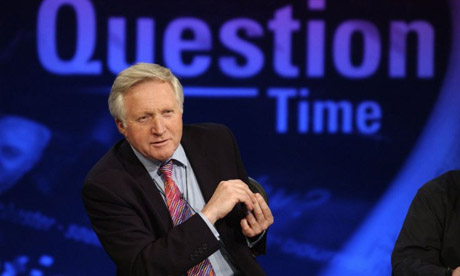
A general election without Dimbleby would be like...a thing without another thing that is very important. (I've slept about as much as Gordon Brown, excuse me). As such, the Dimbster has been on duty from 10pm last night to 9 am. And, as I type, he's back on again.
This man is superhuman. It took an attack by a bull to get him to take his first week off hosting Question Time in decades. Presumably whenever the camera went over to Emily Maitlis on her massive iPad, Dimbleby was taking a bump of cocaine. And all this in the name of democracy.
There were moments when the sleep-deprivation seemed to take its toll, however - and thus the Dimblenator provided my favourite moment of the whole election. Considering the role of the Queen in the event of a hung parliament, Dimbleby announced: 'We go now to our Royalty correspondent, standing outside Buckingham Palace - *absent-mindedly* the Palace...of Buckingham...' Brilliant.
Honourable mention must go, of course, to the other BBC presenters who stayed up well past their bedtimes in the name of news (the aforemtioned Emily Maitlis, Robert Peston, Andrew Marr, baldy Conservato-twat Nick Robinson et al.) but without the Dimbleby British democracy would somehow be far worse off.
Speaking of the state of our so-called Democracy...
2) The Literally Disenfranchised
The only story to overtake the General Election itself was the shocking news of people being kept in enormous queues (and in the rain some places) while an insufficient number of bureaucrats faffed about and denied everybody the right to vote when the clocks struck 10. This is a disgrace, of course, and the electoral commission is going to launch a 'thorough' investigation into the matter.
But the sheer civility of the shafted voters made me so proud to be British. Footage quickly emerged of angry non-voters having a go at polling station staff, and there were plenty of angry interviews to news cameras. Said one: "there were hundreds - particularly young voters - who were queuing for an hour and a half, and I think that it is just not right when hundreds later found themselves unable to excersie their right when the polls closed." Another said, "We've been disenfranchised, and it's not on!"
This is what the British do when denied a fundamental right - queue, and complain. Imagine this in any other country. How would the French react? Or the Greeks, or Romanians, Koreans, you name it? These people showed tremendous patience, lined up in an orderly fashion, became very very displeased and then decided not to kill anyone. I'm not trying to trivialise what was done to these people, and protest in many places went beyond tut tutting and finger wagging (in Hackney they organised a sit-in, and in Sheffield Hallam voters went to Nick Clegg's house with their poll cards to protest). The revolutionary potential of the British is in doubt, but I feel bloody proud all the same.
*Apologies to readers here: my dipshit cunt fucking twat of a shitty fuckwit bastard laptop has just cockblocked me from being able to upload pictures and videos for some fucking reason. 'Technological Revolution' my acheing arse*
2) Caroline Lucas
According to Reuben at the Third Estate, the Green Party assistant press officer was 'almost in tears with ecstacy' over what was, in my view, the most significant win of the whole election. Caroline Lucas, the incredibly impressive and talented leader of the the Green Party, took Brighton Pavilion last night in a close race, and thus Lucas is the UK's first ever Green Member of Parliament.
Now, the strong impression I got from this video, and from the reporting on the election campaign in Brighton, is that the people who voted Green are mostly insufferable arsehole Bohemian types who read the Grauniad, eat organic and...no matter: they won this seat, and well done to them (I guess).
We now have a guaranteed sane person in the Commons, and a real radical.
Good luck Caroline, you'll need it.
3) Mariella Frostrup
Now, if my fucking shit eating bastard motherfucker of a laptop worked as a fucking laptop was meant to, I'd be able to put up a nice picture of the really rather dishy Mariella 'thinking man's crumpet' Frostrup up here, but I can't, for the aforementioned reasons. (I can't even link to a nice picture, as that isn't working either, so just pop 'Mariella Frostrup' into Google images if you require a visual aid).
Anyway. At a very odd election-night event on a boat, featuring everyone from Joan Collins to Simon Schama (really), Andrew Neil sat down with Toby Young, Ian Hislop and Mariella to fill time before the next seat was declared. The subject of the reaction of the financial world was raised (the bankers didn't like the idea of ther Tories not having a big enough majority, and thus the Pound took a dive as uncertainty set in).
From what I could tell, Mariella Frostrup was the only person to challenge the infuriating attitude of every commentator thus far that the whims of completely unaccountable bankers should be considered a perfectly natural part of a general election. Frostrup was visably appalled at Neil's mention of the views and retaliatory actions of the City, and told him outright. He made the case that we should mind what the bankers have to say through their manipulation of the currency, as it's 'their' money the government must pay back, but she slapped that back in his face by saying that it's a disgrace we've become so reliant on the markets in this way in the first place. And right she is.
Later on Stephanie Flanders gave us a full update on the City's reaction, and, again, at no point was the obvious mentioned: that, during an ostensibly democratic election, perhaps the views of finance, expressed in a Ponzi-scheme, shouldn't concern us as much as the views of the elecorate expressed via the ballot box; and that maybe it's a disgrace that business interests are allowed to tank a currency when it doesn't like what the People have decided.
4) Margaret Hodge
Hodge (Labour) managed to soundly defeat Nick Griffin, which is a relief; but the beating the fat goggle-eyed Nazi cunt isn't why she's on this list. Before the declaration for Barking, she gave an interview with Jeremy Paxman, and very confidently dropped the F-bomb several times. The election in Barking, she said, was a defence of 'Democratic values against Fascist values'.
The BNP needs to be called out for what it is: our very own Fascist party. But this isn't said nearly enough. So fuck them. And well done Hodge.
And that's it, I think.
Oh, it should be mentioned that Evan Harris, the Lib Dem MP for Oxford West and Abingdon, lost his seat at this election. This is a phenomenal shame those of us who value science, reason and secularism, all of which Harris worked to defend against an increasing tide of irrationalism. Thus it was Harris who asked a Homeopath in a select committee on the subject of 'alternative' (i.e. unproven) medicine: "So, what about all the poo?", and he also played a decisive part in abolishing the laws covering 'blasphemous libel', for which he won an award from the National Secular Society.
Let's hope he's back in office as soon as bloody possible.
This was my first general election, and if you must know I'm one of an exclusive club of just 1,021 individuals who voted Green in Chipping Barnet. I remember someone once saying that you could pop a blue rossette round a cabbage and it would still get elected here. No matter. The Greens never had a chance in this constituency, but Lucas's win in Brighton made me very happy, as you can imagine.
That's all for now. Stay tuned for an interview with badass Marxist geographer David Harvey. Not that anyone's there. Who are you talking to? Shut up!....
Sunday, 2 May 2010
Today in the Youtubes: US soldiers remake Telephone
These people defend our freedom as we sleep, people.
Saturday, 10 April 2010
In Soviet Union, ladies buy you...
Sent to my Skype.
[14:55:29] dreamsy002: European and American women are too arrogant for you? Are you looking for a sweet lady that will be caring and understanding? Then you came to the right place- here you can find a Russian lady that will love you with all her heart. Can't find a queen to rule your heart? How about beautiful Russian ladies that have royal blood and royal look? Here you can find hundreds of portfolios of these fine women of any age for every taste. Please excuse us if you are not interested.
Beautiful Russian ladies - http://givemelove.net
How many western men are out there looking for an aristocrat who isn't too arrogant? I love how polite they are at the end.
Friday, 2 April 2010
Tuesday, 30 March 2010
Sunday, 28 March 2010
Quote for the Day: Andrew Sullivan
Obama has discovered his balls, and Andrew Sullivan approves:
"Remember healthcare. The key thing to understand about Obama is his persistence. And the key thing Netanyahu needs to be reminded of is: Obama has a gift for getting his enemies to destroy themselves"
In the space of a few weeks Obama has passed healthcare ("historic!" etc etc.), completed a significant deal with Russia over arms and has shown Israel that American support isn't a given, by any means. And he has achieved this by being a persistent dick ("Bush-style", as Bill Maher put it). The fetishism of 'bi-partisanship', a tepid little anti-political sound-bite that's terrorized American politics for too long, may be over. Let's hope, anyway.
Johann on Willett's 'The Pinch', plus Aubrey de Gray
Johann has a great article on the phoney generation war that is well worth reading: http://www.johannhari.com/2010/03/26/as-britain-ages-will-our-politics-be-dominated-by-generational-conflict
The economic and political arguments aside, I still think young people have a right to hate the old - they are old, afterall.
(And this wouldn't be an issue if we just gave this guy lots of money - he has a Rasputin-beard and a biology degree, I trust him):
Saturday, 27 March 2010
A Poem: 'Norman and Saxon', by Rudyard Kipling
Currently reading through Christopher Hitchens' excellent little introductory book (142 pages, plus notes) on Thomas Paine and his 'Rights of Man'. The insights are, unsurprisingly, very interesting, and Hitchens sprinkles his investigation into Paine's thought, life and influence with examples from history and, in particular, songs and lines of verse from every period.
Paine's rebuttal to Burke on the point of heredity and kingship (Burke seemed to argue that the monarchy of England stretched back to before time itself, providing the stability and tradition that made Albion great), was roughly as follows:
1) The unelected rulers of England had taken the country into frivolous and damaging wars, often over no great a matter as to which family member would get to play divine ruler; hardly the mark of 'stability'.
and,
2) There wasn't a continuous line of hereditary monarchs. Paine saw the (often violent) transferral of power between families as usurpations, and always against the consent of the natives.
Paine brought up, in particular, the Norman conquest as an example of this, and from the point of view of those who gained the least from 1066. (He would raise the subject time and again).
Hitchens:
"it is easy to forget...how long and how late the idea of 'the Norman yoke' survived in English and indeed American consciousness. Thomas Jefferson grounded his claim of American rights on the ancient liberties of the Anglo-Saxons, which had not been nullified by a Norman subjugation and which had transferred themselves across the Atlantic and out of the monarchy's reach. There was a popular joke in my own very conservative Hampshire grandfather's day about a dispute between an English peasant and his hereditary landlord. 'Do you realise?' enquires the exasperated squire, 'that my ancestors came over with King William?' 'Yes,' replied the tenant. 'We were ready for you.'"
Quoted after this is Kipling's poem 'Norman and Saxon' (1911). Kipling imagines a Norman aristocrat in the year 1100 giving advice to his first-born son before he dies. In particular, I love the last four words of the second stanza: it says so much.
Norman and Saxon
(A.D. 1100)
"My son," said the Norman Baron, "I am dying, and you will be heir
To all the broad acres in England that William gave me for my share
When we conquered the Saxon at Hastings, and a nice little handful it is.
But before you go over to rule it I want you to understand this:--
"The Saxon is not like us Normans. His manners are not so polite.
But he never means anything serious till he talks about justice and right.
When he stands like an ox in the furrow with his sullen set eyes on your own,
And grumbles, 'This isn't fair dealing,' my son, leave the Saxon alone.
"You can horsewhip your Gascony archers, or torture your Picardy spears;
But don't try that game on the Saxon; you'll have the whole brood round your ears.
From the richest old Thane in the country to the poorest chained serf in the field,
They'll be at you and on you like hornets, and, if you are wise, you will yield.
"But first you must master their language, their dialect, proverbs and songs.
Don't trust any clerk to interpret when they come with the tale of their wrongs.
Let them know that you know what they're saying; let them feel that you know what to say.
Yes, even when you want to go hunting, hear 'em out if it takes you all day.
"They'll drink every hour of the daylight and poach every hour of the dark.
It's the sport not the rabbits they're after (we've plenty of game in the park).
Don't hang them or cut off their fingers. That's wasteful as well as unkind,
For a hard-bitten, South-country poacher makes the best man-at-arms you can find.
"Appear with your wife and the children at their weddings and funerals and feasts.
Be polite but not friendly to Bishops; be good to all poor parish priests.
Say 'we', 'us' and 'ours' when you're talking, instead of 'you fellows' and 'I.'
Dont' ride over seeds; keep your temper; and never you tell 'em a lie!"
Friday, 26 March 2010
The 5 stages of pre-exam breakdowns
Sent from my girlfriend:
The 5 stages of pre-exam breakdowns
1. Denial - "Don't worry it's fine - it's all good, i can deal with it, it won't be to hard, no worries".
2. Anger - Are you fucking kidding me!! This is shit - I dont know any of this how do they expect us to remember this?? "hey mate, calm down" - don't you fucking tell me to calm down - you can fuck off.
3. Bargaining - Shit I wish I didn't have to do this - its all over, I'm going to fail. I would do anything to not have to do this, just one more day to study, anything to get out of this.
4. Depression - It's fucked, I'm fucked, it's all over - HSC over, I'm never going to pass, just give up now and drop out.
5. Acceptance - Yes, I finally acknowledge I am fucked - but nonetheless I will do this exam anyway and hopefully get through it somehow.
2. Anger - Are you fucking kidding me!! This is shit - I dont know any of this how do they expect us to remember this?? "hey mate, calm down" - don't you fucking tell me to calm down - you can fuck off.
3. Bargaining - Shit I wish I didn't have to do this - its all over, I'm going to fail. I would do anything to not have to do this, just one more day to study, anything to get out of this.
4. Depression - It's fucked, I'm fucked, it's all over - HSC over, I'm never going to pass, just give up now and drop out.
5. Acceptance - Yes, I finally acknowledge I am fucked - but nonetheless I will do this exam anyway and hopefully get through it somehow.
LOL.
Thursday, 25 March 2010
For a Civic Culture.

London offers everywhere to shop, and nowhere to sit down. I went shopping with my girlfriend the other day, and to rest our tired feet I thought it would be nice to have a drink in a nearby pub. (I am eighteen, in case you're worried). Pubs have a cultural status far beyond their role as dens of iniquity: if people just wanted to get pissed they wouldn't pay double the price for a drink in a pub than they would from a supermarket. Pubs are the nearest thing we have to a truly public sphere. And this one in particular looked a very attractive place to sit down and have a drink. Unfortunately I had forgotten my travel documents and dental records.
We were asked for I.D (which doesn't happen everywhere), which I didn't have on me. I said I'd just have a lemonade instead. (The sitting down was my priority, anyway). We were asked to leave.
"Sorry, guys," said the twenty-something bar lady "just the rules".
(She was only following orders).
What is the point of these measures? Yes, I should have brought some I.D, but that's not the point. I had agreed not to drink anything alcoholic, and we were still chucked out. Are they worried simply being around alcohol will corrupt me in some profound way? (The same way in which just seeing a copy of a naughty magazine will awaken sexual energies in an adolescent the average 14-year-old can't muster on their own).
Teenagers, it is well known, develop far healthier drinking habits when forced out of the public sphere and the influence of well behaved adults, and preferably into the company of other adolescents, in a park, with access to an air-gun.
We then had to move on, and settled instead for a horrible identikit coffee chain; and the difference between your average pub and the sort of establishment that sells mocha-choca-locha-venti-sized-frappa-mappa-chinos for £15, is immense. The size of a shoe box, this particular venue was about to burst with shopping-laden caffeine addicts and staffed by just one trainee barista with a poor grasp of English. The individual character of one of these cafes is the same as any other cafe in the chain, as they're constructed out of Ikea flat-packs, and the flies on the wall suggested wood rot. This is not public space. The whole experience was thoroughly unpleasant.
The point is that we've built a city which is actively hostile to us; in which the principle goal of urban space is to buy stuff and never stop to enjoy the surroundings. You may think you're part of a great sprawling urban centre of life and culture, but would that still be true if your Oyster card wasn't topped up regularly? Even if I'd been allowed in that pub my right to stay there would be based on my ability to pay.
The Marxist academic David Harvey, a great exponent of the 'right to the city', wrote the following in the New Left Review:
"The question of what kind of city we want cannot be divorced from that of what kind of social ties, relationship to nature, lifestyles, technologies and aesthetic values we desire. The right to the city is far more than the individual liberty to access urban resources: it is a right to change ourselves by changing the city....The freedom to make and remake our cities and ourselves is...one of the most precious yet most neglected of our human rights."
At the moment I don't want to change the social relations of the city, or revolutionize urban life: I just want somewhere to sit down.
Wednesday, 24 March 2010
A Healthier America.
To celebrate the passing of the health reform bill in the United States (about fucking time, Land of the Free), here's some stuff from the archive on the National Health:
Update: If you liked that, here's a posh dead man telling you about the NHS:
Tuesday, 23 March 2010
Monday, 22 March 2010
Yay Journalism! #1: or, Please, have our column inches, rich people, we don't want them...
From today's Evening Standard:
"LONDON business chiefs today called on Alistair Darling to use this week's Budget to get tougher on spending cuts and rein in tax rises on the better off...Urging a stronger focus on cuts, they called for a specialist unit in the Cabinet Office to find spending reductions, staffed by civil servants and senior figures from the private sector.... In other news, reports are still coming in that the Pope is indeed Catholic."
Okay, I added that last bit myself; but I wouldn't have noticed it first time round reading on the Tube. How, exactly, is this a news story? Rich people don't want to pay tax. Well, that's not true every day of the year. Not only that, but the obviously dispassionate views of organised business on public spending are assumed to be newsworthy, to the point now that all of the major newspapers (and the Labour government, to their shame) take it for granted that Britain is undergoing a deficit crisis of Greek proportions, when in fact the UK's deficit before the 2008 crash was lower than Japan, Italy, Germany, France and the United States, many of whom have no trouble getting international loans. (I don't need to mention that the issue of who will be most affected by cuts in public spending isn't raised. Actually, I just did. Yeah, take it).
Something similar has happened with the current battle between arse-wipe managers at BA. ('Capital', by the way) and the more-than-reasonable (as in, willing to take a fucking pay cut) Unite union. ('Labour', just to make sure). The view that the holidays of tourists outweigh the livelihoods of thousands of BA workers is all we can hear; the only BA employees paid any attention are anonymous scabs.
But at least the Standard article afforded me one pleasure: that of seeing the private sector demand cuts in public spending, and then ask for their own 'senior figures' to be given public money to carry this out. Wankers.
Sunday, 21 March 2010
'Zeitgeist Exposed', by somebody else
This great piece appeared recently on The Third Estate, and the (anonymous) author encouraged readers to repost it on their own blogs, and generally try to get it out there.
In Agatha Christie’s classic crime novel the ABC Murders, the detective Hercule Poirot comes up with the following formulation: “When do you notice a pin least? When it is in a pin cushion. When do you notice a murder least? When it is one of a series of related murders.” I would like to extend Poirot’s thinking to “When do you notice an extremely pernicious and dangerous conspiracy theory least? When it is set in a two hour film amongst many other conspiracy theories.”
 Over the last year or so a number of people have told me that I should watch the film Zeitgeist: The Movie. All of these people have been lefties or liberals, and each tells me that the film supplies a good exposé of power in the modern world. These people have been from a wide range of backgrounds and ages, some of them environmentalists, some of them unionists, some of them socialists, some British, some American. The film has achieved massive viewing figures globally, with over 3,000,000 people having watched it on Youtube, and many more on DVD or Google Video. And of all of these people who have recommended the film to me, none has noticed its reliance on the old myth of the “world Jewish conspiracy”.
In this article I hope to expose the film’s relationship to older anti-Semitic texts and myths, and look more closely at how these theories are made to look left-wing or liberal. I wish to explain why this film has become so attractive to people who otherwise are engaged in good struggles against capitalism, against war, and to save the environment. I am particularly interested in the relationship between the film and a book called The Protocols of the Elders of Zion, along with its use of other anti-Semitic tropes that have existed throughout modernity.
Zeitgeist: The Movie is split into three parts: The first focuses on the relationship between astrological symbology and the story of Jesus; the second on “the truth about 9/11″; and the third is about international finance. In all honesty the first part is neither here nor there. The argument is that Christianity is not original in its particular form of mythology, and instead is a reconfiguration of older myths focusing on sun gods. Whether or not we take this argument to be true has very little impact on how we understand modern society. The second section of the film expounds a theory that 9/11 was an inside job, committed by the American state. Many people do believe this, and much of the information is inaccessible, but the argument that I would like to make is that these two conspiracy theories are in many ways inconsequential to the overall meaning of the film. Rather they are used as a smoke screen to justify the dissemination of anti-Semitic material in the final section of the film.
What is The Protocols of the Elders of Zion? The Protocols is a book first published by around the turn of the last century in Russia. It is a fraudulent and fictional document made to read as if written by Jews intent on ruling the world. It suggests that the Jewish people plan on world domination through a process of controlling governments, controlling the media, controlling banks, and swindling the populace at large. The claim is that Jews wish to enslave the world by creating a “one world government.” Of course the text is deeply anti-Semitic, and has been shown numerous times to be a forgery, but has been used consistently throughout the 20th and 21st centuries to justify atrocities committed against Jews. Furthermore it remains popular in parts of the world, and amongst certain right-wing and fascist organisations.
The relationship between two texts
It is easy enough to say that there is a large cross-over of content between Zeitgeistand The Protocols of the Elders of Zion by plucking a few choice quotes. For example, where Zeitgeist says, “International bankers now have a streamlined machine to expand their personal ambitions”, The Protocols says “the wheels of the machine of all the states are moved by the force of the engine, which is in our [the Jews'] hands, and the engine of the machinery of our states is Gold .” But I would suggest that this sort of critique does not go far enough, rather I would like to show that the entire argument of the third section of the film has been lifted from The Protocols. It is the same argument, often in slightly altered language, and as such is just as anti-Semitic. I will focus on five particular aspects: The one world government; the use of war; manipulation of the populace; the focus on gold and money; and the idea of an all-powerful secret cabal.
The One World Government
One of the great fears of the conspiracy theorists is a one world government. This point is made explicitly towards the end of Zeitgeist in a discussion of a North American Union, an Asian Union, the European Union, and an African Union. And finally, they say “when the time is right they will merge together forming the final stages of a plan these men have been working on for over 60 years: a one world government… One bank, one army, one centre of power.” This argument is particularly related to he opening of Protocol 3 in which we read, “Today I may tell you that our [the Jews'] goal is now only a few steps off. There remains but a small space to cross of the long path we have trodden before the cycle of the Symbolic Snake, by which we symbolise our people, will be completed. When this ring closes, all the States of Europe will be locked into its coil as in a powerful vice.” The Protocolsgo on in Protocol 5, “by all these means we shall so wear down the goyim (non-Jews) that they will be compelled to offer us international power of a nature that will enable us to absorb all the State forces of the world and to form a Super-Government.”
The use of war
There is a section in the film in which it is claimed that the justifications for America going into a number of world wars were orchestrated by “men behind the government.” We are told that the sinking of the Lusitania was planned, that the Gulf of Tonkin Incident never happened, that Pearl Harbour was known about well in advance, and of course that 9/11 was an inside job. We are told that both sides of conflicts have been funded by the same “international bankers.” This section of the film is lifted directly from Protocol 7, which reads, “Throughout all of Europe, and by means of relations in Europe, in other continents also, we must create ferments, discords, and hostility. Therein we gain a double advantage. In the first place we keep in check all countries, for they well know that we have the power whenever we like to create disorders and to restore order… We must be in a position to respond to every act of opposition by war with the neighbours of that country which dares to oppose us: but if these neighbours should also venture to stand collectively against us, then we must offer resistance by universal war.”
I am not going to say here that wars haven’t been entered into cynically, because of course they have, and I am also not saying that many wars should not be opposed, because again in many cases they should. The point though, is that the structure of this particular argument about war is based on the idea of Jews running the world, and should thus be thrown out.
Manipulating the populace
There are two branches to classic Jewish conspiracy theory thought about how the people are made stupid and swindled. The first, and in fact the one that has been most significant in the history of Jewish conspiracy theories, is the idea of Jews being in charge of the media. The second, which has become less widely used but still exists in Zeitgeist: The Movie is the idea of Jewish control of the education system to make it ineffective. The issue of Jewish control of the media is covered in Protocol 12 in which it is written, “Not a single announcement will reach the public without our control. Even now this is being attained by us inasmuch as all news items are received by a few agencies in whose offices they are focused from all parts of the world. These agencies will then be already entirely ours (the Jews’) and will give publicity only to what we dictate to them.” And in Protocol 13, “We further distract them [the non-Jews] with amusements, games, pastimes, passions, people’s palaces… Soon we shall begin through the press to propose competitions in art, in sport of all kinds. These interests will finally distract their minds from questions in which we should find ourselves compelled to oppose them.” In Zeitgeist identical issues are covered throughout but in particular there is discussion of a “culture entirely saturated by mass media entertainments.” We are told that the same people behind the planned takeover of society are “behind the mainstream media.”
In both Zeitgeist and The Protocols we see some discussion of the education system. In Zeitgeist we are told about the “downward slide of the US education system” and that “They [the government] do not want your children to be educated.” Completely unsurprisingly the same argument is made in Protocol 16: “When we are in power we shall remove every kind of disturbing subject from the course of education and shall make out of the youth obedient children of authority.” The narrator of Zeitgeistsays, “the last thing the men behind the curtain want is a conscious, informed public”, echoing the sentiment from Protocol 5 that “there is nothing more dangerous to us (the Jews) than personal initiative.”
The focus on gold or money: the federal reserve, and Jewish usury
Both The Protocols (particularly Protocols 21 and 22) and Zeitgeist focus heavily on issues regarding money or gold. Both offer the theory that the problems of society are caused by money and systems of money being controlled by a small group of people of questionable morals. What is important here is the focus is on money rather than on capital or production. Instead of offering critical perspectives on the structures within society that cause oppression and poverty, the general view is society as it stands is benevolent and this benevolence is subverted by problems in the sphere of circulation.
Over the centuries, going back as far as the expulsion of the Jews from Britain in 1290, the charge of usury has been levelled against the Jews for anti-Semitic purposes. Zeitgeist says of the federal income tax, “roughly 25% of the average worker’s income is taken via this tax, and guess where that money goes? It goes to pay the interest on the currency being produced by the Federal Reserve Bank. The money you make working for almost three months out of the years goes almost literally into the pockets of the international bankers.” Again, for the sake of trying not to appear as racist as they really are, the word Jew is replaced with “international bankers.” This is once again a restatement of an anti-Semitic myth. Just as in all of these examples, the arguments here are lifted from older anti-Semitic theories. They are not offering an explanation of world or national political economic systems, rather they exist solely to foster an attitude of hatred to a certain pre-defined section of society.
A secretive cabal?
Ultimately, the argument that is being made throughout Zeitgeist is that the world is being controlled by a small secret society of individuals, and in the context of the history of conspiracy theories, they are talking about the Jews. When we are told by the film about meetings of these “international bankers” that are “secretive and concealed from public view”, discussions about “an accelerated agenda by the ruthless elite”, or “people behind the government” they are breathing new life into an old racist myth that we must try to do away with.
There is an insistence throughout conspiracy theories that someone or some group of people are personally responsible for all of the ills of the world, and this is very much related to anti-Semitism throughout modernity. For hundreds of years, Jews have been the officially sanctioned scapegoat of capitalism. Where systems of production have impoverished people, the Jews have been blamed; where people have felt taxes are unfair, the Jews have been blamed; where people have felt alienated by the structures of society, they have been told that they are in fact alienated because they are not part of secret meetings of Jews. Ultimately these theories lead us away from a critique of capitalism. Slovenian philosopher, Slavoj Zizek makes exactly this point with reference to Wagner’s anti-Semitism when he writes “He needs a Jew: so that, first, modernity – this abstract impersonal process – is given a human face, is identified with a concrete, palpable feature; then, in a second move, by rejecting the Jew which gives full body to all that is disintegrated in modernity, we can retain its advantages. In short, anti-Semitism does not stand for anti-modernism as such, but an attempt at combining modernity with social corporatism which is characteristic of conservative revolutionaries.”
Who was Senator Louis McFadden? Louis McFadden, who is quoted at length inZeitgeist, was a senator in the US in the first part of the twentieth century. He also happened to be a serious anti-Semite, and came out with lines such as, “in the United States today, the Gentiles have the slips of paper while the Jews have the lawful money.” He is quoted twice in the film saying the following: “A world banking system was being set up here… a superstate controlled by international bankers acting together to enslave the world for their own pleasure…” and “It was a carefully contrived occurrence. International bankers sought to bring about a condition of despair so they might emerge rulers of us all.” Within the context of McFadden’s world view, he is using “international bankers” as an epithet for Jews. What is notable is that the makers of Zeitgeist seem keen to omit this context, to suggest that McFadden is simply offering a critique of capitalism. The fact is that within conspiracy theories the labelling of Jews as “international bankers” and “international finance capital” is a common trope. These quotes would have been understood at the time, and is still understood by many now, to be anti-Semitic gestures.
The Case of Jeremiah Duggan, and the truth about Lyndon LaRouche
Another rather shady character who appears in Zeitgeist is American political activist Lyndon LaRouche. I felt I should include the following story as anecdotal evidence of quite how dangerous these people can be:
 Jeremiah Duggan was a British Student at the Sorbonne who died in 2003 in extremely suspicious circumstances. In the months leading up to his death, Duggan had become involved in what he believed to be an anti-war organisation. In fact he had become entangled with a set of political organisations headed up by American political activist Lyndon LaRouche. In March that year, Duggan attended a conference of these organisations at the Schiller Institute (a site owned by LaRouche’s movement) in Wiesbaden, Germany. During the course of meetings Duggan revealed himself to be Jewish, and yet in such meetings of LaRouche’s movement, Jews are blamed for starting the war, reanimating the old conspiracy myths about the Jews encouraging wars as they aid social control. He said in his keynote address to the conference, “This plot to launch a new world war has been intellectually influenced by people who, like Hitler, admire Nietzsche, but “being Jewish, they couldn’t qualify for Nazi Party leadership, even though their fascism was absolutely pure! As extreme as Hitler! They sent them to the United States.[…] Who’s behind it? . . . The independent central-banking-system crowd, the slime-mold. The financier interests.”
At around 5am, after Duggan had revealed his Jewish identity at the conference, he phoned his mother. He said, “Mum, I’m in … big trouble … You know this Nouvelle Solidarité? ..” He said, “I can’t do this” … I want out.” And at that point the phone was cut. And then it rang back again almost immediately. … And then the first thing that he said that time was, “Mum, I’m frightened.” She realized he was in such danger that she said to him, “I love you.” And then he said, “I want to see you now.” She said, “well, where are you, Jerry?” And he said, “Wiesbaden.” And she said, “How do you spell it?” And he said, “W I E S.” And then the phone was cut.
The next day, Jeremiah was found dead, with members of LaRouche’s movement claiming that he had committed suicide. Inquests are still ongoing to determine what happened that night. In the last few weeks a second inquiry into his death has been announced.
LaRouche has been known as a Jewish conspiracy theorist for more than 30 years now. His organisation is cultish and dangerous (one of the reasons I choose to write this anonymously), and the content of much of what he says can be traced back to the sort of allegations put forward by The Protocols of the Elders of Zion. What, then, is a man like this doing in a film that purports to be a lefty-liberal critique of society?
Zeitgeist and the Left
What is in many ways most unsettling about this film is the fact that it purports to be left-wing or liberal. As the film ends we see images of three men faded in and out: Mahatma Gandhi, Martin Luther-King, and John Lennon. Throughout the film we have quotations from left wing comedian Bill Hicks and a section is given to New Labour politician Michael Meacher. It is asserted once again that the aim of this film is the affirmation of the unity of humanity, of doing away with difference, whether it be class, race, or sex. We are made to think that the film is offering a radical left critique of power. Instead it is indulging in the sort of theories that are more at home with right-wing libertarians. I do not know entirely why the Zeitgeist group are particularly targeting the left. It is perhaps a divisive measure, but also possibly just an arena where they feel they can convert people to their way of thinking. What is clear, though, is that the suggestion that the ideas expressed are left-wing or liberal, and the deployment of quotations from well known lefties and liberals, is utterly cynical.
The positivist problem
There is one reason in particular that these conspiracies may seem compatible with left wing modes of thought, and that is to do with the philosophical problem of positivism. Stated in its simplest form, this is that ideas about transforming a society cannot be straightforwardly expressed in the language or accepted modes of thought of the society that they wish to transform. And this issue is common to all transformative theories of society. Probably the most influential branch of this type of thinking stemmed from Hegel to Marx, and then into Marxists of the 20th and 21st century. The solution for them is to talk in terms of a dialectic, that is, by comparing the consciousness of a society to the material reality. The significant conclusion of this type of thought is that one’s consciousness of society, up to a certain point is always false.
The conspiracy theorists take on this question in another way. They say that if our consciousness of society is always false, it is made to be false by a small number of powerful who make it false. They believe that we are consistently duped by an all-knowing cabal who control every aspect of our lives. And the solutions differ too. For the Marxists and socialists the problem is that society produces a consciousness that doesn’t allow us to fully understand our immiseration in work, in unemployment, or in powerlessness, and the solution is the radical transformation of society to a fairer, less exploitative world. For the conspiracy theorists the answer is the elimination of this so-called small powerful elite. They do not believe that society needs any more transformation than this.
This is difficult philosophical ground to tread. We run a huge risk if we are to criticise the conspiracy theorists for not being positivists, not working within accepted modes of thought. Instead, what we must say is that their particular critical mode of thought does not propose a correct solution for solving society’s problems, and furthermore is reliant not on unity but on division. We must show that inequality in society is structural rather than being based on the wishes of a small group of Jews.
What is to be done?
Zeitgeist: The Movie is ever growing in popularity, and furthermore they are building a movement. More and more people are being influenced by what the film has to say, without realising quite where it is coming from. It is important that as widely as possible we can expose the anti-Semitic subtext to this film. We must expose the film as being cynically positioned to influence liberals and lefties. In targeting the ideas presented by Zeitgeist it is not enough to just quibble over details, rather we must be trying to understand the politics that this film overall is trying to portray. We need to read through the many layers of conspiracy theories here, and understand that there is one in particular that they want us to believe, and that this one is, of course, the most dangerous and pernicious.
It is important to understand that the type of critique of society offered by theZeitgeist movement cannot be separated from the Jewish conspiracy theory. One cannot take classic anti-Semitic texts, replace the word “Jew” with “international bankers”, or “international finance capital” and then believe that your theory is no longer anti-Semitic. Of course there are very good arguments that capitalism and indeed imperialism are extremely dangerous. There are very good arguments from a left or liberal perspective to say that the wars in Afghanistan and Iraq should never have been fought. And it is here that we must recognise that ends do not justify means. We cannot afford to support any cause that is simply anti-capitalist, or any cause that is simply anti-war, otherwise we run the risk of getting into bed with fascists. Rather, our positions on capitalism and of war must arise from thoroughgoing critique, rather than a rehashing and rebranding of old anti-Semitic narratives.
In order to spread this message as widely as possible I encourage you to republish this piece on your own websites, to send it to friends and comrades, to show it to anyone who tells you about “this fabulous new film you just have to watch.” One of the easiest ways is, if you are on twitter, to just click the tweet button at thee top of this post. If possible, do track back to us here at The Third Estate so we can monitor how widely this material is being disseminated. In coming weeks I will be recreating this article as a voice-over video, much in the style of Zeitgeist: The Movie in order that we can spread these views to even more people who may be influenced by this abhorrent film.
Subscribe to:
Comments (Atom)


